What Are Fractional Sales Directors Really Selling?
Hint: It is not more sales.
Ask most Fractional Sales Directors what they do and the answer is usually predictable.
“I help businesses increase sales.”
It is true.
It is also the same answer used by sales trainers, lead-generation agencies, CRM providers, recruiters, consultants and almost every salesperson who wants to win work from a growing business.
The problem is not that increasing sales is unimportant.
It is the outcome every client wants.
The problem is that it does not explain what is actually broken—or what you are being hired to change.
A business can increase sales for a quarter through a large referral, one outstanding salesperson, a discounting push or a founder working twelve-hour days.
That is not predictable growth.
That is a result.
And results that rely on the right person being available at the right time are difficult to repeat.
So what are Fractional Sales Directors really selling?
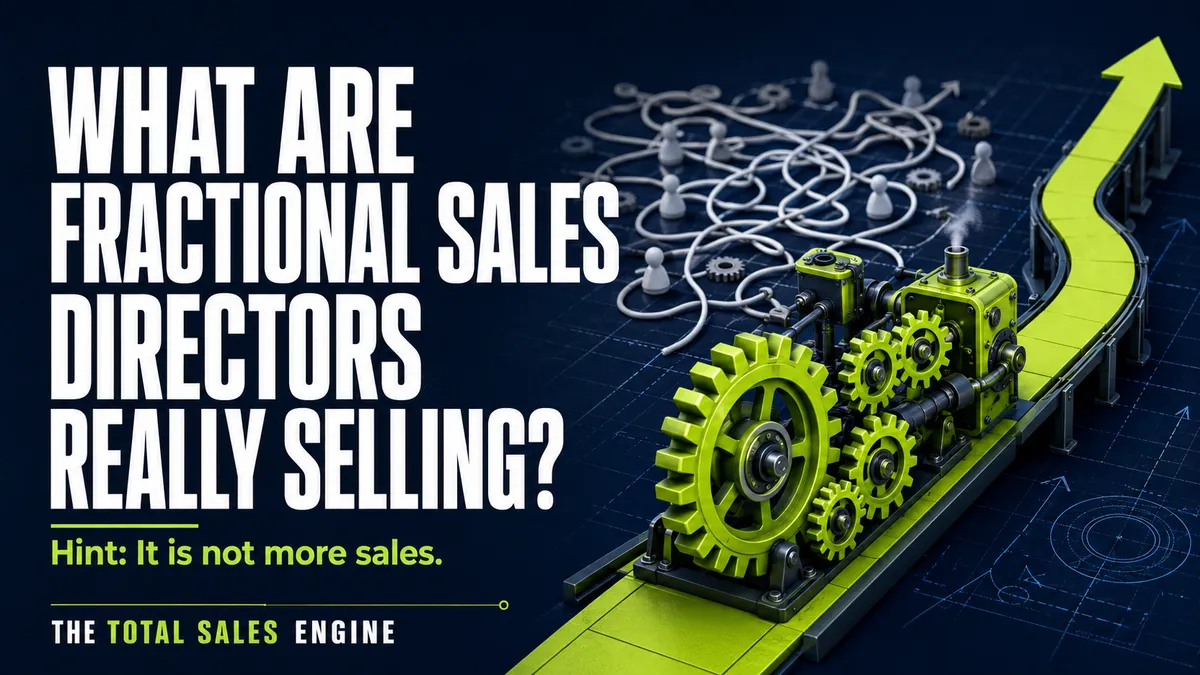
They are helping businesses overcome Sales Chaos.
They are replacing sales that depends on founders, key people, memory, heroic effort and random bursts of activity with a repeatable way to create, progress and retain revenue.
More sales is the by-product.
Sales is a people business. That is exactly why it needs a system.
Some people will push back on this.
“Sales is about relationships.”
It is.
“You cannot systemise trust.”
You cannot.
“People buy from people.”
They do.
But none of that means a business should rely on one person to remember every follow-up, qualify every opportunity, prepare every proposal, manage every relationship and rescue every deal when it becomes difficult.
That is not relationship-led selling.
That is people dependency.
And people dependency is one of the most expensive forms of Sales Chaos.
When the founder is the only person who can convert a meaningful opportunity, sales slows whenever they are busy.
When the best salesperson is the only person who knows how to run a good discovery meeting, the business does not have a sales process. It has one capable individual.
When follow-up happens only because someone remembers, the pipeline is not being managed. It is being hoped for.
When every difficult client conversation ends up with the owner, the business has not built commercial capability. It has built an escalation path back to one person.
That may work while the business is small.
It becomes a ceiling when the business wants to grow.
More sales is the outcome, not the offer
The obvious response to an underperforming sales function is to ask for more activity.
More leads.
More calls.
More meetings.
More proposals.
More people.
Sometimes that is the right answer.
Often, it is not.
More leads will not help a business that does not follow up properly.
More meetings will not help a team that cannot qualify the right opportunities.
More salespeople will not solve an unclear strategy, weak management or a CRM full of deals nobody owns.
More marketing will not fix a business that wins clients but cannot retain or expand them.
The business may need more sales.
But first it needs to know why sales are not predictable now.
That is the distinction.
A Fractional Sales Director is not there to become another pair of hands, attend more meetings or add another opinion to the weekly forecast.
They are there to identify the constraint, install the right infrastructure and create the rhythm that allows the business to perform consistently.
The real product is a Sales Engine
A Sales Engine is not software.
It is not a CRM.
It is not a sales script, an outbound campaign or a dashboard that looks impressive in a management meeting.
A Sales Engine is the combination of strategy, systems, support and performance leadership that enables a business to create predictable growth.
It answers the questions that most Sales Chaos hides:
Who are we targeting?
What commercial problem do we solve?
What does a good opportunity look like?
How are the right conversations created?
What happens after someone shows interest?
Who owns the next step?
How is the pipeline reviewed?
Where is the team getting stuck?
What support does the sales team need to execute consistently?
How do we know whether performance is improving?
When those questions have clear answers, sales stops depending on instinct and individual memory.
People still make the calls.
People still build trust.
People still lead the important conversations.
But they are supported by a commercial system that makes good execution more likely.
That is the difference between having good salespeople and having a business capable of producing sales consistently.
Sales Rhythm is what makes the Engine work
A Sales Engine gives the business the structure.
Sales Rhythm makes sure the structure is used.
This is where many businesses get stuck.
They buy technology. They run training. They create a process. They hold a launch meeting. Everyone agrees that things need to improve.
Then delivery gets busy.
The founder has client issues to manage.
The senior salesperson is focused on a large deal.
The CRM is updated later.
Follow-up is pushed to next week.
The sales meeting becomes a discussion about why the number was missed.
Within a few months, the business is back where it started.
That is why Sales Rhythm matters.
It creates the cadence that keeps the critical work moving:
Prospecting happens even when delivery is demanding.
Follow-up does not depend on someone remembering.
Opportunities are reviewed before they go cold.
Proposals are sent with a clear next step.
Sales meetings create commitments, not explanations.
Performance issues are identified early enough to do something about them.
You do not fix sales with pressure.
You fix it with rhythm.
What the client is really buying
The client may initially ask for more leads, a better sales team or help improving conversion.
Those are valid starting points.
But the deeper need is usually bigger.
They want confidence that their commercial performance is no longer held together by the founder.
They want visibility over what is working and what is not.
They want the team to know what good looks like, what they own and what needs to happen next.
They want a reliable way to create opportunities instead of waiting for referrals or reacting when the pipeline becomes empty.
They want clients to receive consistent follow-up, clear communication and a better commercial experience.
They want growth without needing to become the emergency service every time a deal stalls.
That is what they are buying.
Not a part-time Sales Director.
Not another consultant who produces recommendations.
Not a promise to “increase sales.”
They are buying the shift from Sales Chaos to predictable growth.
The Fractional Sales Director’s job
This is why the role should be positioned differently.
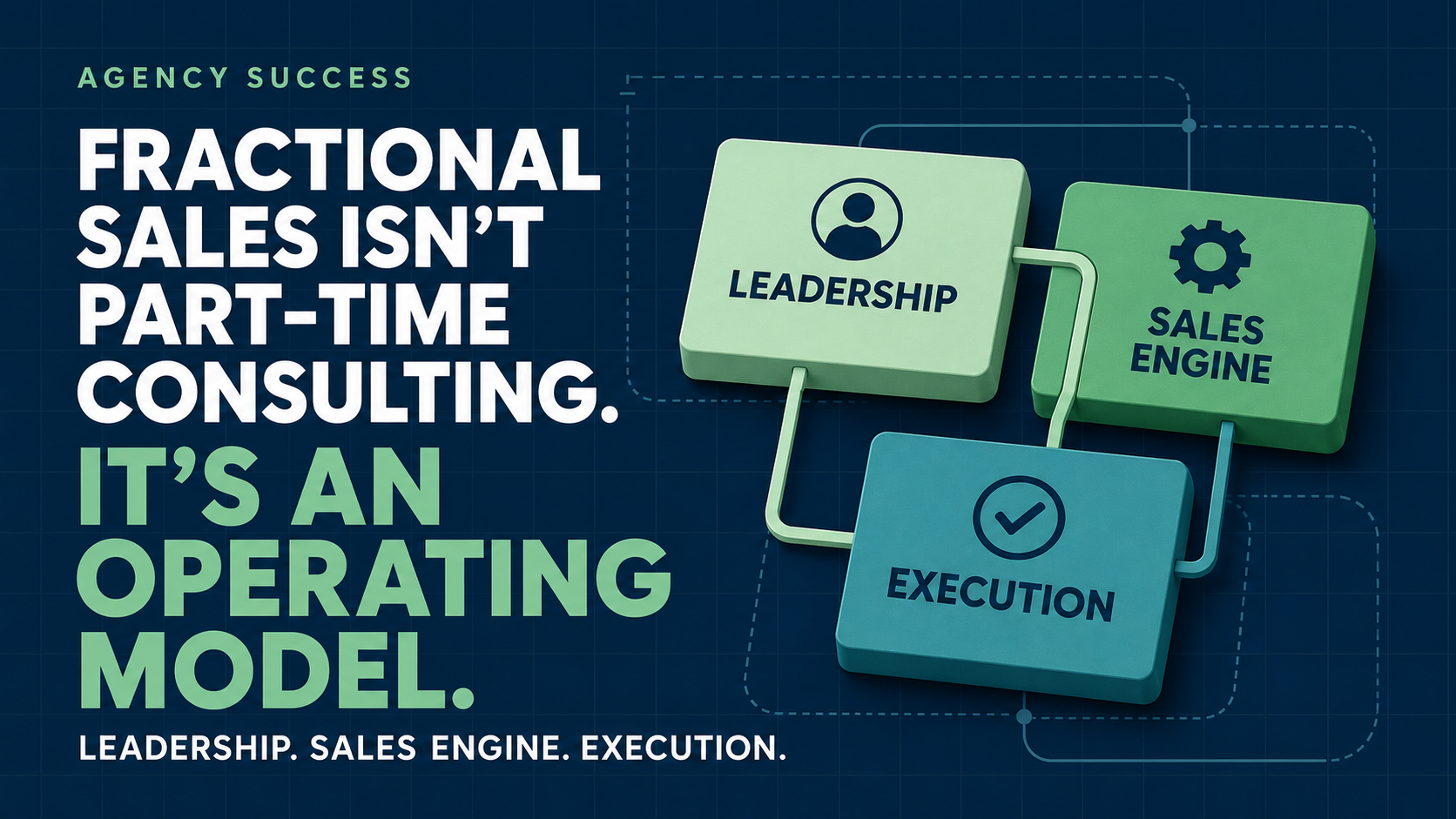
A good Fractional Sales Director is not simply an experienced salesperson available a few days a week.
They are a commercial leader who can help a business see reality, identify the right problem and build the capability to solve it.
They should be able to:
Diagnose where revenue is being lost.
Identify the profit lever that will create the greatest impact.
Clarify the sales strategy and ideal client.
Install a process the team can follow.
Create the support required to protect high-value selling time.
Establish a rhythm for activity, accountability and review.
Develop the people responsible for execution.
Give the founder visibility without making them responsible for every decision.
That is a very different offer from “I can help with sales.”
It is more valuable because it addresses the cause, not only the symptom.
It is more credible because it gives the client a clear transformation.
And it is more scalable because the work is not dependent on the Director personally doing every task forever.
Stop selling access to your time
This is the trap many experienced sales leaders fall into when they move into fractional work.
They sell their availability.
A day a week. Two days a week. A monthly retainer. Support wherever it is needed.
The client buys access to an experienced person.
The Fractional Sales Director becomes busy.
But the scope expands, the client relies on them for every important decision and the work starts to resemble another senior role—with less certainty and more demands.
That is not the model.
The model is to sell a defined commercial transformation.
Start by understanding the current reality.
Identify the constraint.
Install the Engine.
Create the Sales Rhythm.
Support the team to execute.
Measure what improves.
This gives the client a clearer journey and the Director a business model they can scale without becoming trapped inside every client’s day-to-day operation.
The real promise
Fractional Sales Directors do help businesses increase sales.
But that is not the promise.
The promise is stronger:
We help businesses overcome Sales Chaos by replacing reliance on key people with the systems, support and Sales Rhythm required to unlock predictable growth.
That is what makes the work valuable.
And it is what gives experienced sales leaders the opportunity to build something more than a consulting practice based on their personal availability.
You are not selling more sales.
You are helping clients build the capability to create them—again and again, without needing one person to hold the entire commercial function together.
If you want to build a Fractional Sales business around a proven commercial transformation, explore the Total Sales HQ Certified Partner Program.