Fractional Sales: What It Is, What It Isn't And Why It Matters
Fractional Sales is becoming one of those terms that means different things depending on who is using it.
For some, it means an experienced sales leader working inside a business for one or two days each week.
For others, it means sales consulting, outsourced prospecting, interim management or coaching delivered under a different name.
But working fewer days doesn’t automatically make something Fractional Sales.
The number of days is probably the least important part of the model.
Done properly, Fractional Sales gives SMEs access to experienced commercial leadership, proven systems and consistent execution without expecting another full-time sales manager to build everything alone.
That distinction matters.
Fractional Sales isn’t a part-time job
A part-time sales manager is still an employee operating inside the existing structure of the business.
They attend meetings, manage the team, report to the owner and work within the systems they inherit.
If those systems are weak, they usually spend their limited time compensating for them.
A Fractional Sales Leader should bring more than additional management capacity.
They should bring an established methodology, commercial perspective and the infrastructure needed to improve how the business sells.
The objective isn’t to fill a seat for two days each week.
It is to create an outcome.
Fractional Sales isn’t traditional consulting
Consultants are generally paid to analyse a problem and recommend what the business should do next.
The advice may be excellent. The strategy may be correct. The presentation may clearly explain what needs to change.
Then the consultant leaves.
The business is left to implement the recommendations alongside everything else already competing for time and attention.
That is where many consulting engagements lose momentum.
The issue usually isn’t the quality of the advice. It is the distance between knowing what to do and doing it consistently.
Fractional Sales closes that distance.
The Fractional Sales Leader stays involved in the execution, leads the commercial priorities and holds the rhythm together while the new systems and behaviours become established.
We don’t sell consulting and leave clients with another list of recommendations.
We install Sales Engines.
Fractional Sales isn’t sales training
Training can improve knowledge and capability.
It can teach people how to run better discovery conversations, qualify opportunities, handle objections and negotiate more effectively.
But training alone rarely fixes a broken sales operation.
A salesperson can leave a training session motivated and still return to:
An unclear market
Weak positioning
An inconsistent pipeline
Poorly defined sales stages
Missing follow-up
Unreliable reporting
Conflicting priorities
A founder who steps into every important deal
Those are operating problems, not simply skill problems.
Fractional Sales may include coaching and development, but the work goes deeper.
It improves the environment in which the team is expected to perform.
Fractional Sales isn’t outsourced appointment setting
Lead generation is part of sales, but it isn’t the whole Sales Engine.
An outsourced prospecting company may create conversations. It usually doesn’t decide which market the business should pursue, strengthen the offer, improve conversion, manage the pipeline or lead the sales team.
More meetings don’t automatically create more revenue.
If qualification is weak, positioning is unclear or follow-up is inconsistent, additional leads simply enter the same broken process.
Fractional Sales looks across the full commercial system.
That includes generating opportunities, but it also includes conversion, average transaction value, client retention and the operating disciplines connecting everything together.
So, what is Fractional Sales?
Fractional Sales is an embedded commercial leadership model designed to help a business improve its sales performance without building every capability through full-time internal hires.
It brings together four things.
Experienced sales leadership
The Fractional Sales Leader establishes reality, sets the commercial direction and makes the decisions needed to move the business forward.
They bring experience without forcing the SME to carry the cost and risk of another senior full-time appointment before the business is ready.
A clear sales strategy
The business needs clarity around its market, offer, positioning, pricing, priorities and route to growth.
Without that clarity, activity becomes scattered and the team spends more time reacting than executing.
A repeatable Sales Engine
The strategy must be translated into processes, CRM stages, measures, playbooks, responsibilities and operating routines.
This is what allows the business to repeat what works rather than relying on individual effort or memory.
Daily execution support
Someone still needs to complete the research, maintain the CRM, manage follow-up, update reporting and keep agreed actions moving.
In the Total Sales model, this work is supported by a Sales Co-Pilot—a trained human member of the operational support team, not an AI assistant.
The Fractional Sales Leader sets the direction.
The Sales Engine makes the direction executable.
The Sales Co-Pilot helps keep the Engine moving.
What does the Fractional Sales Leader actually do?
The role changes depending on the needs and maturity of the business, but the core responsibility remains the same:
Create the commercial capability needed to produce more consistent results.
That can include:
Diagnosing where revenue and momentum are being lost
Establishing the sales strategy
Clarifying positioning and priorities
Installing a structured sales process
Improving pipeline visibility
Leading sales meetings
Coaching the team
Strengthening discovery and conversion
Creating accountability
Managing performance
Building the systems and support required for execution
The goal is not to make the client permanently dependent on the Fractional Sales Leader.
It is to leave the business stronger than it was before the engagement began.
Why does this matter to SMEs?
Most SMEs reach a point where founder-led selling is no longer sustainable, but hiring a full internal sales leadership team is still difficult to justify.
The owner may be closing the important deals, managing the team and carrying the forecast while also trying to run the business.
Something has to change.
The traditional answer is to hire another senior person and hope they can build the missing capability while delivering immediate results.
Fractional Sales offers another path.
The business can access senior leadership, a proven operating model and daily support while building the foundations needed for long-term growth.
It can establish what works before committing to more permanent headcount.
That reduces risk, creates visibility and helps the owner step away from being the person holding every deal together.
Why does this matter to experienced sales leaders?
For the sales leader, Fractional Sales creates an opportunity to build something different from another employed role or traditional consultancy.
But only if the model is structured correctly.
A sales leader who sells days, delivers everything personally and becomes indispensable to every client hasn’t built an agency.
They have built another job.
A Fractional Sales Agency creates leverage by combining leadership with recurring revenue, repeatable systems, technology and operational support.
The leader remains responsible for the client outcome, but they don’t have to complete every task required to create it.
That allows them to serve clients at a higher level, produce more consistent results and build a business that becomes less dependent on their personal capacity.
What good Fractional Sales looks like
Good Fractional Sales should create visible change inside the client’s business.
The strategy becomes clearer.
The pipeline becomes more reliable.
Follow-up happens consistently.
Meetings lead to decisions.
Everyone understands what good performance looks like.
The founder is no longer required to rescue every important deal.
The business begins to operate with rhythm.
If everything stops when the Fractional Sales Leader isn’t in the room, the right systems haven’t been built.
If the business becomes more capable, more consistent and less dependent on individual heroics, the model is working.
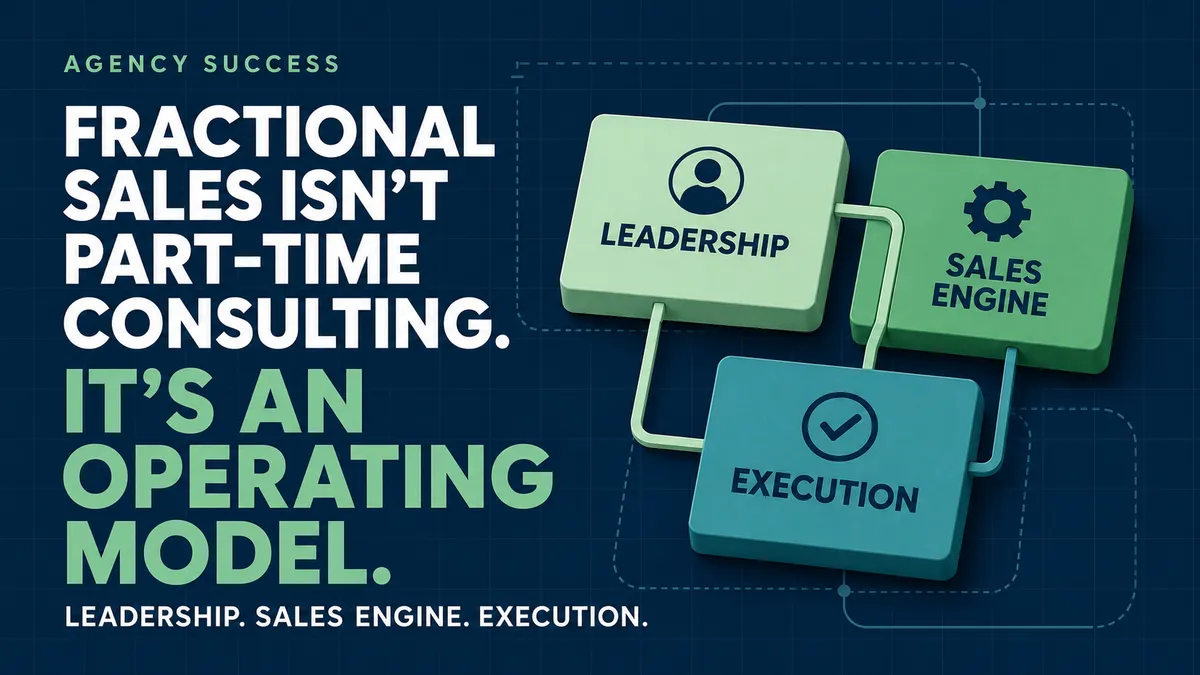
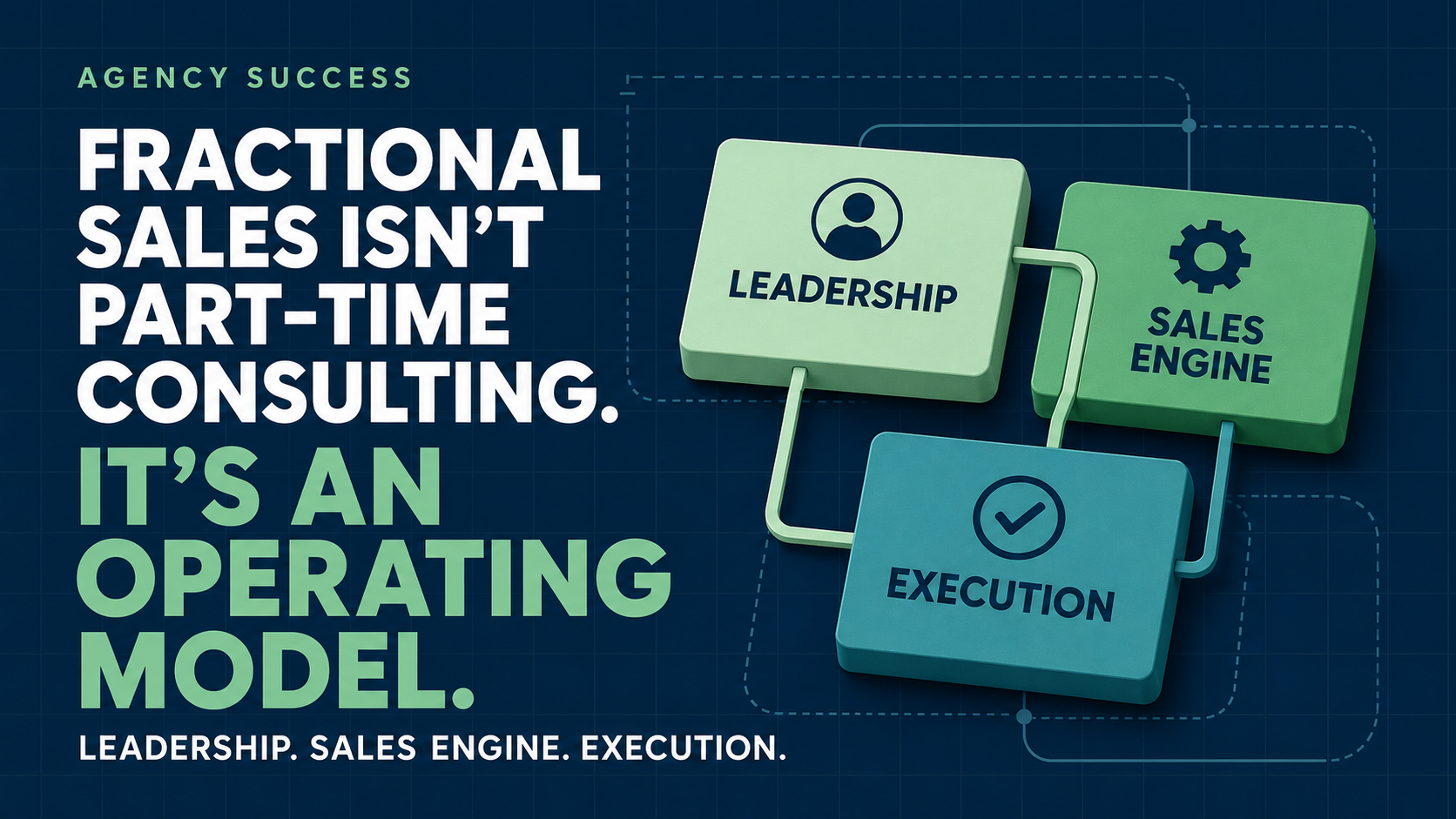
It is an operating model, not a job title
Fractional Sales isn’t defined by how many hours or days someone works.
It is defined by the commercial capability they build.
Done badly, it becomes consulting with a new label.
Done well, it gives SMEs the leadership, systems and support needed to overcome Sales Chaos, create Sales Rhythm and unlock Predictable Growth.
It also gives experienced sales leaders the opportunity to build businesses based on outcomes, recurring revenue and leverage rather than selling their time.
That is what Fractional Sales is.
And that is why it matters.