
Have You Built Yourself Another Job? The Fractional Sales Trap
Going from contract to contract is not the same as building a business.
There is a pattern I see regularly with experienced sales leaders moving into fractional work.
They are good at what they do. They have led teams, won complex deals and improved commercial performance. They usually have a decent network and enough credibility to win an early client or two.
So far, so good.
Then the client work takes over.
They are leading meetings, working through the sales strategy, helping with deals, building process, dealing with the CRM, chasing follow-up and supporting the people around the client.
At the same time, they are trying to market themselves, create content, maintain their network, research new prospects and keep their own pipeline moving.
Something gives.
Usually, it is their own business development.
The client work is urgent. It pays today. It has deadlines. The next conversation can wait until tomorrow.
Then tomorrow becomes next week. Next week becomes a month. One engagement changes direction or ends, and suddenly the Fractional Sales Leader is looking around for the next client with no real pipeline behind them.
That is when fractional work starts to feel unstable.
Not because there is no demand for experienced sales leadership.
Because they have built a business that depends on them doing everything personally.
There Is Nothing Wrong With A Traditional Fractional Practice
If you want one or two clients, enjoy the work and are happy selling a portion of your time each month, that can be a good business.
But it has limits.
Your income is largely tied to your availability. The client is buying access to you. If you are busy delivering, you have less time to find future work. If a client leaves, you need to replace that income yourself.
Many people enter fractional work because they want more freedom than corporate life gives them.
Then, without meaning to, they recreate the same dependency in a different form. They still have one or two sources of income. They still have limited control over their pipeline. They are still exposed when a decision is made above their head.
The problem is not the retainer.
The problem is treating the retainer as the whole model.
A Job And A Business Require Different Thinking
When you see Fractional Sales as a job, the questions are straightforward:
Who is my next client?
What can I charge?
How much time will they need from me?
How do I keep them happy?
Those are sensible questions. They are also incomplete.
When you are building a business, you need to ask:
What will continue to create conversations while I am delivering client work?
How will people know what I stand for before I need another client?
What can clients buy from me beyond access to my time?
Which parts of delivery need my experience and judgement, and which parts should be handled by systems or support?
How do I stop a client ending from putting me back to zero?
That is the distinction.
A job pays you for the work you personally complete.
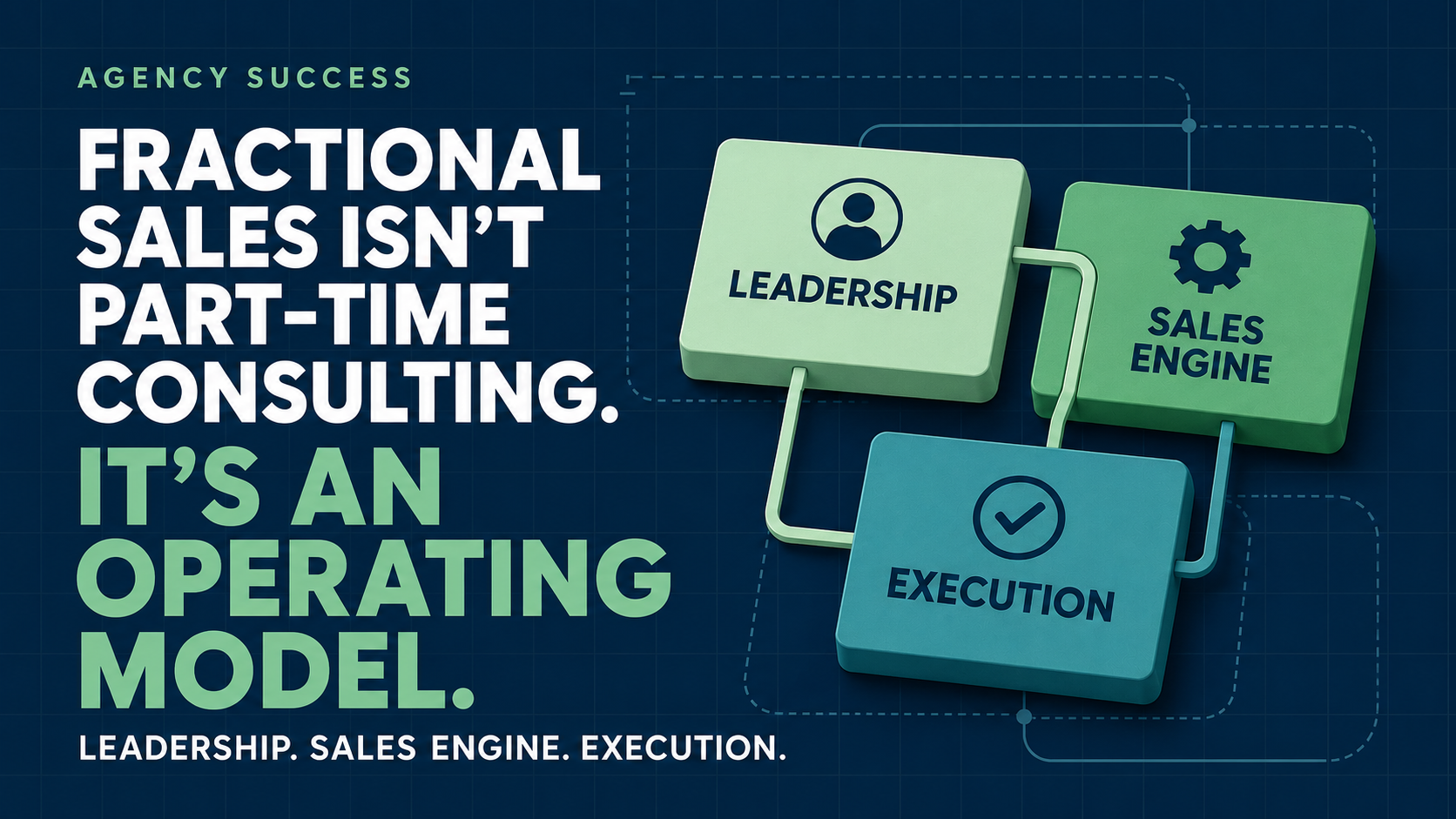
A business builds assets, systems, relationships and support around your expertise so it can keep creating value without everything depending on your availability.
The Time Between Engagements Is Where Most Fractional Dreams Die
Most Fractional Sales Leaders do not fail because they cannot deliver.
They fail in the gaps.
They get a client, get busy and stop generating demand. They rely on referrals, a post that did well months ago or the hope that their network will come through when they need it.
Then a contract ends.
Now every conversation matters too much.
The wrong prospect gets too much attention. Price becomes negotiable. Poor-fit work starts to look attractive. The sales leader begins trying to convince people who were never going to buy.
That is not a confidence problem.
It is what happens when there is no reliable system for creating conversations.
You cannot build a stable agency by turning business development on only when a client leaves.
You Cannot Carry Every Part Of The Business Forever
There are things a Fractional Sales Leader should own.
Commercial conversations. Client relationships. Diagnosis. Strategy. Decisions. Leadership. Helping a client see what needs to change and keeping that change moving.
There is also a long list of work that has to happen around those things:
Research
Prospecting
Content distribution
CRM updates
Meeting preparation
Follow-up
Reporting
Pipeline visibility
Client administration
Process documentation
That work matters. It protects the rhythm.
But it does not all need to be done by the person leading the client.
If it is, the Fractional Sales Leader becomes the constraint on their own growth. They are too busy to market, too busy to follow up and too busy to build the next opportunity.
The answer is not to remove yourself from the client relationship.
It is to build enough support around the relationship that you can stay focused on the work clients actually value you for.
This Is What An Ecosystem Is For
The word “ecosystem” gets used too loosely, so let’s be specific.
For a Fractional Sales Leader, it means having support and infrastructure around the parts of the business that are difficult to sustain alone.
It means having a way to build authority through content, events and shared conversations rather than trying to become a full-time content creator.
It means having systems and people supporting research, follow-up, CRM discipline and the daily work that keeps opportunities moving.
It means having a clear client journey: workshops, implementation, ongoing leadership, systems and support. Not every client will buy every part of it, but you are not limited to a single monthly retainer for your time.
It means operating alongside other experienced leaders who can challenge your thinking, share what is working and help you avoid solving every problem from scratch.
Most importantly, it means having a business that can continue to create demand while you are busy creating results for clients.
The Goal Is Not To Give Up Your Independence
The goal is not to become an employee again.
It is not to hide behind someone else’s brand.
It is not to surrender the relationships, expertise or reputation you have spent years building.
The goal is to stop carrying work that does not need to sit on your shoulders.
Your experience is still what clients are buying.
Your leadership is still what creates change.
But the systems, people and assets around you are what allow that experience to become a business with more stability, more leverage and more options.
That is the opportunity in building a Fractional Sales Agency.
Not simply replacing your salary with a few contracts.
Building something that does not fall apart every time one ends.