
Don’t Hire A Salesperson Into Chaos
Why more businesses need Fractional Sales Leadership before they make another full-time sales hire.
A business hires a salesperson.
They pay them a six-figure salary. Give them a target. Add them to the CRM. Tell them to “go and build pipeline.”
Nine months later, there are no meaningful results.
No reliable pipeline.
No clear view of what is working.
No repeatable process.
No confidence that hiring another salesperson would make any difference.
So the business concludes it hired the wrong person.
Maybe it did.
But more often, it hired that person into the wrong environment.
A salesperson cannot fix a business with no commercial strategy, no defined sales process, no useful data, no management rhythm and no agreement about what good sales performance even looks like.
They have not been given a role.
They have been given a mess.
And then everyone acts surprised when they fail.
The Hire-And-Hope Trap
Most businesses do not deliberately set their salespeople up to fail.
They are busy. The founders are stretched. Delivery is consuming the week. Sales is inconsistent, so the obvious answer feels like more sales resource.
“Let’s hire someone.”
It sounds sensible.
But hiring does not create a sales system.
A new salesperson still needs to know:
Who are we trying to win?
What problem do we solve better than anyone else?
What does a qualified opportunity look like?
How do we start conversations?
What happens after a prospect responds?
What is the sales process?
Who owns each step?
What gets measured every week?
What support is available when a deal stalls?
If the answers are vague, the salesperson is forced to invent the system while trying to hit target.
That is not a fair test of their ability.
It is not a sales role.
It is a commercial rescue mission.
And most salespeople—regardless of how talented they are—will struggle to succeed in it.
The Expensive Lesson Businesses Keep Repeating
I recently heard a familiar story.
A business had hired an experienced salesperson on a substantial package.
Nine months later, they had not held a single meaningful face-to-face meeting.
The hire had failed. The business had spent a significant amount of money. Everyone was disappointed.
But when you looked beneath the headline, the problem was obvious.
There was no system to support the person.
No clear commercial strategy.
No defined process.
No playbooks.
No reporting rhythm.
No meaningful management framework.
No agreed expectations.
The business had hired someone and hoped they would somehow make the chaos disappear.
Then, after the hire failed, the debate started again.
“Do we hire internally?”
“Do we get external help?”
That is the wrong debate.
The real question is:
What needs to be in place before the next sales hire has a genuine chance of succeeding?
Until a business can answer that question clearly, hiring another salesperson is not a plan.
It is a gamble.
This Is Why Fractional Sales Leadership Exists
Fractional Sales Leadership is not about replacing every permanent sales leader.
It is not about creating dependency on an outside consultant.
And it is not another person showing up with a strategy deck, giving advice and leaving the business to work out the hard part alone.
The right Fractional Sales Leader helps a business build the conditions in which sales can work.
That means getting clear on the commercial direction.
It means identifying where revenue is leaking: leads, conversion, transaction value or client lifetime value.
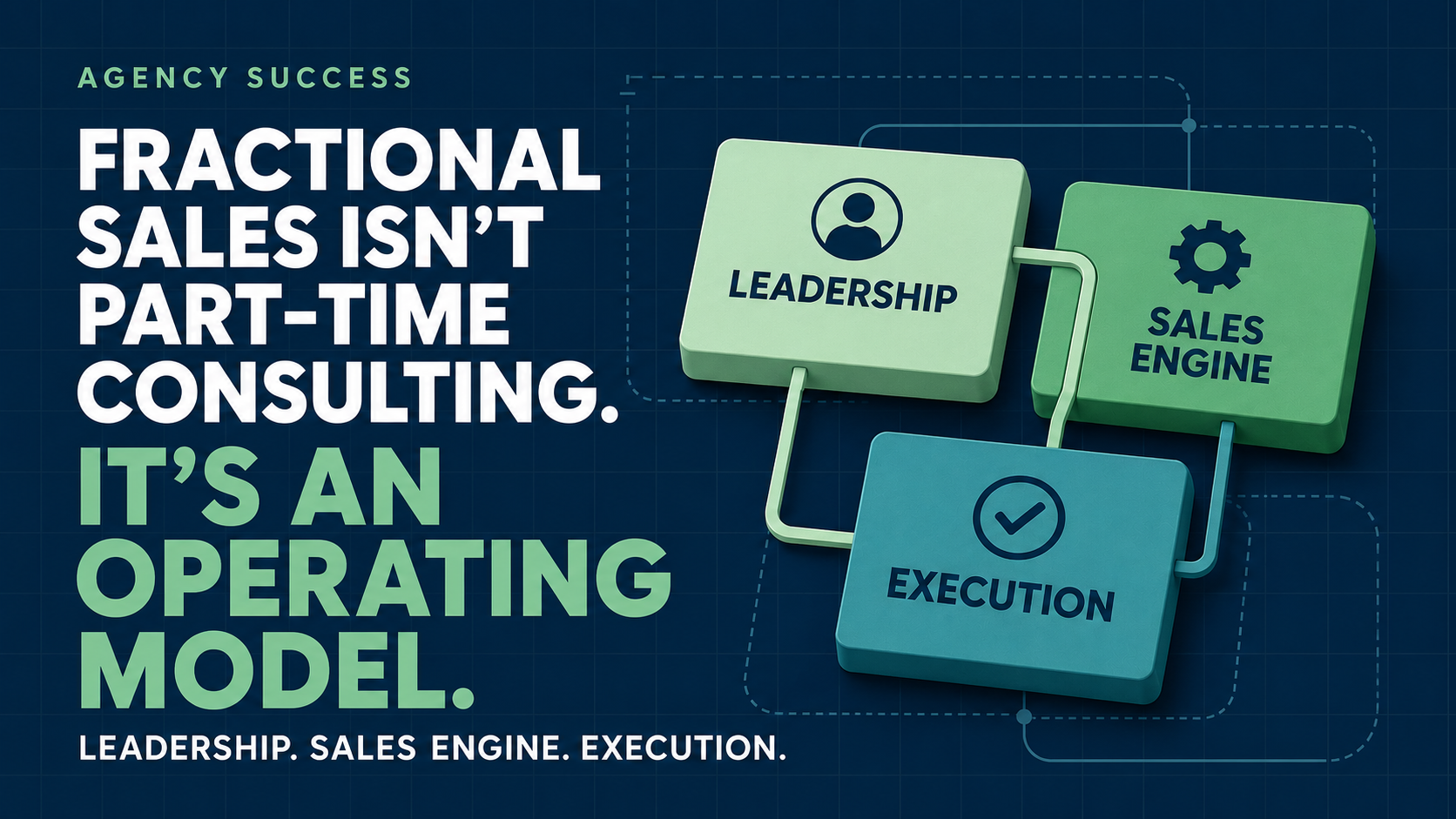
It means installing the sales process, systems, playbooks, reporting and rhythm that make performance visible and repeatable.
It means clarifying who owns what.
It means supporting the business to build capability—not remain dependent on the Fractional Sales Leader forever.
Then, when the business eventually does hire internally, that person walks into something far more valuable than a vague job description and an ambitious target.
They walk into a functioning Sales Engine.
The Choice Is Not Internal Or External
This is where many business owners get stuck.
They say:
“We need someone internally.”
They are often right.
A growing business will eventually need permanent commercial leadership or a dedicated salesperson.
But that does not make Fractional Sales Leadership the alternative.
It makes it the logical first step.
The choice is not:
“Do we hire internally or get external help?”
The choice is:
“Do we hire someone into the same chaos again—or do we build the structure that gives the next hire a chance of winning?”
A Fractional Sales Leader can help the business define the role properly.
They can help establish the scorecard, the process, the systems and the weekly management rhythm.
They can help the business work out what capability it genuinely needs—and what it should not expect one person to solve alone.
They can even support recruitment, onboarding and early leadership of the right hire.
That reduces risk.
It shortens the time between hiring and productive activity.
And it gives the business a far better chance of getting a return on the investment it is about to make.
Capacity Is Not Capability
One of the most common mistakes I see is a business confusing spare capacity with commercial capability.
“We have an engineer who can help build the process.”
“We have someone with time on their hands.”
“We can write the playbooks internally.”
Maybe they can.
An engineer may be capable of documenting a workflow. A project manager may be able to organise a task list. A founder may be able to explain how they have historically won business.
But a sales system is not a collection of documents.
It requires commercial judgement.
It requires someone who can identify the gaps, challenge assumptions, define the right behaviours and build a process that works in the real world—not just on a whiteboard.
If the business already had that capability internally, it would not be having the conversation.
That is not an insult.
It is simply the reality of specialisation.
A business does not ask a salesperson to design a complex engineering solution because they have spare capacity.
It should not ask an engineer to design and lead its commercial function for the same reason.
The Question Fractional Sales Leaders Should Ask
If you are building a Fractional Sales Agency, you will hear prospects say they need to hire a salesperson.
Do not automatically agree.
Ask them:
“What will that person walk into on day one?”
Will they have a clear strategy?
A defined target market?
A process they can follow?
A CRM that creates visibility rather than admin?
A pipeline they can work?
A sales manager who knows how to lead them?
Clear measures of success?
The right support around them?
If the answer is vague, you have found the real problem.
The business does not need another salesperson first.
It needs the commercial foundations that make hiring worthwhile.
That is the work of Fractional Sales Leadership.
Not to become permanent.
Not to create dependence.
But to bring clarity to chaos, build the structure, create the rhythm and give the business a sales function worth scaling.
Before it spends another dollar on the next hire.