Your First Fractional Sales Client Is Not the Business
Your first fractional sales client can feel like the breakthrough.
Someone trusts you. They see the value of your experience. They are prepared to pay for your help.
After years in employed sales leadership, that first agreement proves something important:
You can do this independently.
But it does not yet prove you have built a business.
It proves you have won a client.
Those are not the same thing.
A first client often comes through a former colleague, an existing relationship, a referral or a conversation that arrives at exactly the right time. That is a great place to start.
But if the next client depends on another lucky introduction, another personal favour or another month of starting from zero, you have not created a repeatable fractional sales business.
You have created a good first engagement.
The real opportunity is bigger than that.
It is to build a business with a clear market, a clear offer and a reliable way to start the right client conversations—so you can win, retain and serve a small portfolio of valuable clients without working twice as hard for less money.
The first client can disguise the real challenge
Most people entering fractional sales focus on one question:
“How do I get my first client?”
It is a reasonable question. Without a first client, there is no revenue, proof or momentum.
But it can also lead people to take the wrong approach.
They tell everyone they are “available for fractional sales work.”
They offer to help with anything commercial.
They accept small advisory projects with no clear outcome.
They price cautiously because they are still trying to prove themselves.
And they say yes to work that creates income, but not necessarily a business they want to own.
The first client then becomes a demanding job with less security.
The work is reactive. The scope is unclear. The client expects senior sales leadership, strategy, hands-on execution, reporting and constant availability—often for a fee that does not justify the time involved.
That is not a failure of capability.
It is a failure to build the commercial model before filling it with clients.
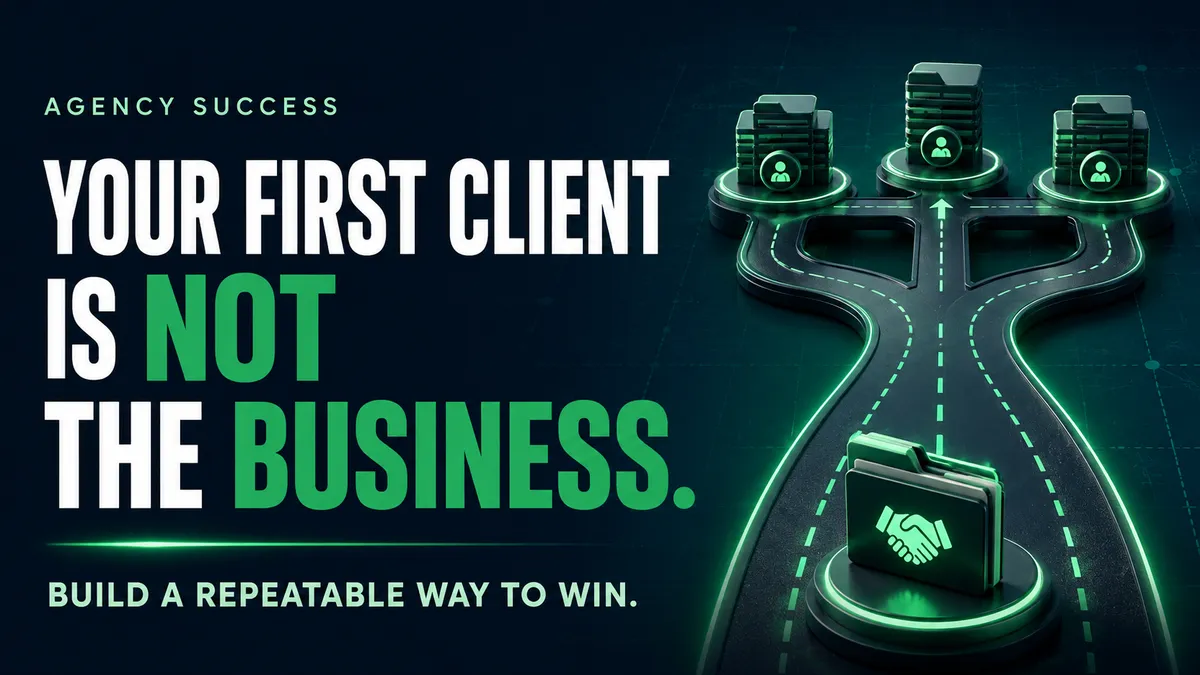
A client is an event. A business is a system.
Winning one client is an event.
Building a business means creating a system that makes the next good client more likely.
It means being able to answer questions such as:
Who are we best placed to help?
What commercial problem are we known for solving?
What does our offer actually include?
Why should a business choose us instead of hiring another full-time sales manager?
Where will the next conversations come from?
How do we deliver results without personally doing every piece of work?
What needs to happen for a client to stay, expand or refer us?
If those answers only exist in your head—or change with every prospect—you are still selling yourself as an experienced individual.
That may generate work.
It does not create the leverage that makes fractional sales commercially attractive.
The goal is not more clients. It is the right client portfolio.
The model does not require a huge number of clients.
In fact, taking on too many clients too early is one of the fastest ways to lose control of your time and reputation.
The goal is to build a portfolio of right-fit businesses where your experience creates a meaningful commercial outcome—and where the work can be delivered with a clear rhythm, defined scope and proper support.
That usually means clients who:
have a real growth objective;
have enough commercial complexity to value experienced leadership;
cannot justify or do not need another full-time sales manager;
are willing to follow a disciplined process;
have the capacity to act on the work;
value outcomes, not just access to your time.
A fractional sales business becomes more valuable when it is built around a defined kind of client and a defined kind of problem.
That gives you a clearer message, stronger conversations and a more repeatable way to sell.
“Fractional sales leadership” is not an offer
It describes how you work.
It does not tell a client why they should buy.
Most SME founders are not looking for a fractional sales leader because they want a part-time version of a corporate title.
They want help solving a commercial problem.
They may be dealing with an inconsistent pipeline. A founder-dependent sales process. Weak follow-up. A team without clear accountability. Forecasts they do not trust. Plenty of activity but no predictable path to revenue.
Your experience is the mechanism.
The outcome is what they buy.
This is why a signature product matters.
Instead of presenting yourself as available for a broad range of sales support, define a clear commercial journey. For example:
diagnose the current sales constraint;
build or repair the sales engine;
establish weekly sales rhythm and accountability;
support the team to execute consistently;
give the founder visibility without making them the bottleneck.
That is easier for a client to understand, value and buy than “I can help with sales.”
It is also easier for you to deliver consistently.
Referrals are valuable—but they cannot be your only route to market
Your relationships are an advantage. Use them.
Former clients, colleagues, suppliers, partners and professional contacts can all become early conversations, introductions and opportunities.
But referrals alone are not a commercial strategy.
They are unpredictable. They arrive when they arrive. And if you rely on them completely, every quiet period can feel like a threat.
A sustainable fractional sales business needs more than one route to market.
That may include:
reconnecting with the people who already know your work;
building referral partnerships with trusted advisers;
targeted outreach to a clearly defined market;
thought leadership that demonstrates your point of view;
diagnostic workshops or commercial reviews that create an easier entry point;
a structured follow-up process that keeps good conversations moving.
None of this requires becoming a full-time marketer or spending every day posting on LinkedIn.
It requires a repeatable rhythm.
A defined audience. A credible message. A reason to start a conversation. Consistent follow-up. A clear next step.
The same sales fundamentals you would expect a client to build.
The business must protect your time as it grows
The trap is simple.
You win a client because of your seniority and experience. Then you personally handle every sales meeting, every piece of analysis, every follow-up task, every CRM update and every report.
The client is getting value.
But your capacity is disappearing.
Soon, you are busy—but you cannot take on another client without sacrificing delivery quality. You are no longer building a fractional sales business. You are operating as an overcommitted consultant.
The right model separates leadership from the work that can be systemised, supported or delegated.
Your highest-value contribution is usually in:
diagnosing the commercial problem;
leading important client conversations;
shaping strategy and priorities;
coaching the sales team;
making high-value commercial decisions;
holding the client accountable for progress.
Research, outreach administration, CRM discipline, follow-up coordination, reporting and routine process management still matter enormously.
But they do not all need to depend on you.
This is where operational infrastructure and trained support create leverage. They protect your time for the work clients value most, while ensuring the day-to-day rhythm does not disappear whenever you are in meetings or delivering for another client.
Build the second-client test
Before you become too focused on winning the first engagement, ask a more useful question:
“If I signed a client this month, what would make the second and third client easier to win and serve?”
The answer should not be “work harder.”
It should be:
a clearer ideal client profile;
a stronger commercial message;
a defined offer;
a reliable way to generate conversations;
a process for progressing those conversations;
case studies and proof created from early results;
delivery systems that prevent every client from becoming bespoke;
support that protects your capacity.
That is the difference between chasing opportunities one conversation at a time and building an agency that can grow deliberately.
Your first client matters. Just do not mistake it for the finish line.
The first client creates confidence.
The second begins to create proof.
The third and fourth test whether you have a model.
But the real objective is not simply to accumulate clients.
It is to build a business that gives you income, ownership and control over how you use your experience.
A business where your sales leadership creates outcomes for clients without requiring you to rebuild the entire operation from scratch every time you win work.
That is what makes the fractional model powerful.
You are not leaving one sales role to create another job for yourself.
You are turning the experience you have spent years developing into a commercial asset you own.
The question is not only:
“Can I win my first fractional sales client?”
It is:
“Can I build a repeatable business that reliably wins and retains the right ones?”
That is the work worth building.
[Insert CTA image/link: Explore the Certified Partner Program]